NEET Ecosystem previous year questions
39 questions on Ecosystem from 18 NEET and AIPMT papers, 2014 to 2026, newest first; on average 2.2 a paper. Open a question for NTA's official answer.
Answers are NTA's official final key, shown for NEET 2021, NEET 2022, NEET 2023, NEET 2023 (Manipur), NEET 2025 and NEET 2026 Re-Examination (21 June). The other papers are given without answers until NTA's key for them is in hand; we do not put an answer of our own in its place. The questions are from published copies of each paper, not from NTA's own booklets, so a word here and there may differ from the printed paper. Chapter-wise weightage
NEET 2026 Re-Examination (21 June)
NTA's answer
Answer: (4) Herbivores
From NTA's final answer key for NEET 2026 Re-Examination (21 June).
i. Energy flow from producers to consumers is unidirectional.
ii. Energy pyramid can never be inverted.
iii. Transfer of energy follows the 1% law.
Choose the correct answer from the options given below:
NTA's answer
Answer: (3) (i) and (ii) only
From NTA's final answer key for NEET 2026 Re-Examination (21 June).
NEET 2026 (3 May)
| List I | List II | ||
|---|---|---|---|
| i. | Productivity | a. | Gross primary productivity minus respiration losses |
| ii. | Net primary productivity | b. | Rate of formation of new organic matter by consumers |
| iii. | Gross primary productivity | c. | Rate of biomass production |
| iv. | Secondary productivity | d. | Rate of production of organic matter during photosynthesis |
Answer
NTA's official answer key for NEET 2026 (3 May) is not in hand yet. This page will carry the answer when it is; we do not put an answer of our own in its place.
| List I | List II | ||
|---|---|---|---|
| i. | Decomposition | a. | Accumulation of dark coloured amorphous colloidal substance |
| ii. | Detritus | b. | Release of inorganic nutrients by the activity of microbes in soil |
| iii. | Mineralisation | c. | Breaking down of complex organic matter into inorganic substances |
| iv. | Humification | d. | Dead remains of plants and animals including fecal matter |
Answer
NTA's official answer key for NEET 2026 (3 May) is not in hand yet. This page will carry the answer when it is; we do not put an answer of our own in its place.
Answer
NTA's official answer key for NEET 2026 (3 May) is not in hand yet. This page will carry the answer when it is; we do not put an answer of our own in its place.
NEET 2025
Statement I: The primary source of energy in an ecosystem is solar energy.
Statement II: The rate of production of organic matter during photosynthesis in an ecosystem is called net primary productivity (NPP).
In the light of the above statements, choose the most appropriate answer from the options given below:
NTA's answer
Answer: (1) Statement I is correct but statement II is incorrect
From NTA's final answer key for NEET 2025.
Statement I: In ecosystem, there is unidirectional flow of energy of sun from producers to consumers.
Statement II: Ecosystems are exempted from 2nd law of thermodynamics.
In the light of the above statements, choose the most appropriate answer from the options given below:
NTA's answer
Answer: (1) Statement I is correct but statement II is incorrect
From NTA's final answer key for NEET 2025.
NTA's answer
Answer: (2) (KCal m-2)yr-1
From NTA's final answer key for NEET 2025.
NEET 2024
Answer
NTA's official answer key for NEET 2024 is not in hand yet. This page will carry the answer when it is; we do not put an answer of our own in its place.
NEET 2023 (Manipur)
| List - I | List - II | ||
|---|---|---|---|
| i. | Hydrarch succession | a. | Gradual change in the species composition |
| ii. | Xerarch succession | b. | Faster and climax reached quickly |
| iii. | Ecological succession | c. | Lichens to mesic conditions |
| iv. | Secondary succession | d. | Phytoplankton to mesic conditions |
NTA's answer
Answer: (2) i – d, ii – c, iii – a, iv – b
From NTA's final answer key for NEET 2023 (Manipur).
NTA's answer
Answer: (3) Standing state
From NTA's final answer key for NEET 2023 (Manipur).
NEET 2023
i. Detritivores perform fragmentation.
ii. The humus is further degraded by some microbes during mineralization.
iii. Water soluble inorganic nutrients go down into the soil and get precipitated by a process called leaching.
iv. The detritus food chain begins with living organisms.
v. Earthworms break down detritus into smaller particles by a process called catabolism.
Choose the CORRECT answer from the options given below:
NTA's answer
Answer: (4) i, ii, iii only
From NTA's final answer key for NEET 2023.
GPP is Gross Primary Productivity
NPP is Net Primary Productivity
R here is ______.
NTA's answer
Answer: (2) Respiratory loss
From NTA's final answer key for NEET 2023.
NEET 2022
Statement I: Decomposition is a process in which the detritus is degraded into simpler substances by microbes.
Statement II: Decomposition is faster if the detritus is rich in lignin and chitin.
In the light of the above statements, choose the correct answer from the options given below:
NTA's answer
Answer: (1) Statement I is correct but Statement II is incorrect
From NTA's final answer key for NEET 2022.
NTA's answer
Answer: (1) Weathering of rocks
From NTA's final answer key for NEET 2022.
NTA's answer
Answer: (4) Fragmentation
From NTA's final answer key for NEET 2022.
NEET 2021
NTA's answer
Answer: (4) Standing state
From NTA's final answer key for NEET 2021.
R represents:
NTA's answer
Answer: (1) Respiration losses
From NTA's final answer key for NEET 2021.
NTA's answer
Answer: (3) Pyramid of biomass in sea is generally upright.
From NTA's final answer key for NEET 2021.
NEET 2020
| (a) | Fourth trophic level | (i) | Crow |
| (b) | Second trophic level | (ii) | Vulture |
| (c) | First trophic level | (iii) | Rabbit |
| (d) | Third trophic level | (iv) | Grass |
Answer
NTA's official answer key for NEET 2020 is not in hand yet. This page will carry the answer when it is; we do not put an answer of our own in its place.
Answer
NTA's official answer key for NEET 2020 is not in hand yet. This page will carry the answer when it is; we do not put an answer of our own in its place.
NEET 2019
Answer
NTA's official answer key for NEET 2019 is not in hand yet. This page will carry the answer when it is; we do not put an answer of our own in its place.
NEET 2018
Secondary consumer : 120 g
Primary consumer : 60 g
Primary producer : 10 g
Answer
NTA's official answer key for NEET 2018 is not in hand yet. This page will carry the answer when it is; we do not put an answer of our own in its place.
NEET 2017
Answer
NTA's official answer key for NEET 2017 is not in hand yet. This page will carry the answer when it is; we do not put an answer of our own in its place.
Answer
NTA's official answer key for NEET 2017 is not in hand yet. This page will carry the answer when it is; we do not put an answer of our own in its place.
NEET 2016 Phase II
Answer
NTA's official answer key for NEET 2016 Phase II is not in hand yet. This page will carry the answer when it is; we do not put an answer of our own in its place.
NEET 2016 Phase I
Answer
NTA's official answer key for NEET 2016 Phase I is not in hand yet. This page will carry the answer when it is; we do not put an answer of our own in its place.
Answer
NTA's official answer key for NEET 2016 Phase I is not in hand yet. This page will carry the answer when it is; we do not put an answer of our own in its place.
Answer
NTA's official answer key for NEET 2016 Phase I is not in hand yet. This page will carry the answer when it is; we do not put an answer of our own in its place.
AIPMT 2015 Re-Test
Answer
NTA's official answer key for AIPMT 2015 Re-Test is not in hand yet. This page will carry the answer when it is; we do not put an answer of our own in its place.
Answer
NTA's official answer key for AIPMT 2015 Re-Test is not in hand yet. This page will carry the answer when it is; we do not put an answer of our own in its place.
| (1) | Gaseous nutrient cycle | Sulphur and Phosphorus |
| Sedimentary nutrient cycle | Carbon and Nitrogen | |
| (2) | Gaseous nutrient cycle | Carbon and Nitrogen |
| Sedimentary nutrient cycle | Sulphur and Phosphorus | |
| (3) | Gaseous nutrient cycle | Carbon and Sulphur |
| Sedimentary nutrient cycle | Nitrogen and Phosphorus | |
| (4) | Gaseous nutrient cycle | Nitrogen and Sulphur |
| Sedimentary nutrient cycle | Carbon and Phosphorus |
Answer
NTA's official answer key for AIPMT 2015 Re-Test is not in hand yet. This page will carry the answer when it is; we do not put an answer of our own in its place.
AIPMT 2015
Answer
NTA's official answer key for AIPMT 2015 is not in hand yet. This page will carry the answer when it is; we do not put an answer of our own in its place.
Answer
NTA's official answer key for AIPMT 2015 is not in hand yet. This page will carry the answer when it is; we do not put an answer of our own in its place.
Answer
NTA's official answer key for AIPMT 2015 is not in hand yet. This page will carry the answer when it is; we do not put an answer of our own in its place.
Answer
NTA's official answer key for AIPMT 2015 is not in hand yet. This page will carry the answer when it is; we do not put an answer of our own in its place.
AIPMT 2014
plant → mice → snake → peacock
Answer
NTA's official answer key for AIPMT 2014 is not in hand yet. This page will carry the answer when it is; we do not put an answer of our own in its place.
| Column I | Column II | ||
|---|---|---|---|
| a. | Earthworm | i. | Pioneer species |
| b. | Succession | ii. | Detritivore |
| c. | Ecosystem service | iii. | Natality |
| d. | Population growth | iv. | Pollination |
Answer
NTA's official answer key for AIPMT 2014 is not in hand yet. This page will carry the answer when it is; we do not put an answer of our own in its place.
| i. | ii. | iii. | iv. | |
|---|---|---|---|---|
| (A) | Rock minerals | Detritus | Litter fall | Producers |
| (B) | Litter fall | Producers | Rock minerals | Detritus |
| (C) | Detritus | Rock minerals | Producers | Litter fall |
| (D) | Producers | Litter | Rock minerals | Detritus |
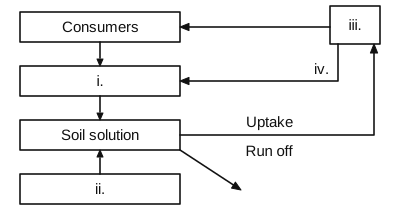
Answer
NTA's official answer key for AIPMT 2014 is not in hand yet. This page will carry the answer when it is; we do not put an answer of our own in its place.