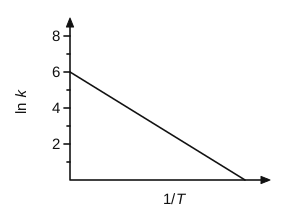
For an elementary chemical reaction, the Arrhenius plot is given below.
If the energy of activation is 6.64 kJ mol-1 and R = 8.3 J K-1 mol-1, the temperature at which the rate constant becomes e2min-1, is:
NEET Chemistry · Class 12 · 34 questions · 2014 to 2026
NEET Chemical Kinetics previous year questions
34 questions on Chemical Kinetics from 18 NEET and AIPMT papers, 2014 to 2026, newest first; on average 1.9 a paper. Open a question for NTA's official answer.
Answers are NTA's official final key, shown for NEET 2021, NEET 2022, NEET 2023, NEET 2023 (Manipur), NEET 2025 and NEET 2026 Re-Examination (21 June). The other papers are given without answers until NTA's key for them is in hand; we do not put an answer of our own in its place. The questions are from published copies of each paper, not from NTA's own booklets, so a word here and there may differ from the printed paper. Chapter-wise weightage
NEET 2026 Re-Examination (21 June) (2)NEET 2026 (3 May) (3)NEET 2025 (2)NEET 2024 (3)NEET 2023 (Manipur) (2)NEET 2023 (2)NEET 2022 (2)NEET 2021 (2)NEET 2020 (2)NEET 2019 (Odisha) (2)NEET 2019 (2)NEET 2018 (2)NEET 2017 (2)NEET 2016 Phase II (1)NEET 2016 Phase I (2)AIPMT 2015 Re-Test (1)AIPMT 2015 (2)
NEET 2026 Re-Examination (21 June)
NEET 2026 Re-Examination (21 June) · Q49 · Temperature for a given rate constant from an Arrhenius plot
NTA's answer
Answer: (4) 200 K
From NTA's final answer key for NEET 2026 Re-Examination (21 June).
NEET 2026 Re-Examination (21 June) · Q77 · Time for 75% completion of a zero-order reaction
2A →(k) B is a zero-order reaction, where k = 1.0 mol L-1min-1. If the initial concentration of A is 2 M, then the time taken to complete 75% of the reaction will be:
NTA's answer
Answer: (3) 0.75 min
From NTA's final answer key for NEET 2026 Re-Examination (21 June).
NEET 2026 (3 May)
NEET 2026 (3 May) · Q56 · Matching reaction orders with units of the rate constant
Match List I with List II:
| List I (Order of reaction) | List II (Unit of rate constant) | ||
|---|---|---|---|
| i. | Zero order | a. | mol-1 L s-1 |
| ii. | First order | b. | mol-2 L2 s-1 |
| iii. | Second order | c. | s-1 |
| iv. | Third order | d. | mol L-1 s-1 |
Choose the CORRECT answer from the options given below:
Answer
NTA's official answer key for NEET 2026 (3 May) is not in hand yet. This page will carry the answer when it is; we do not put an answer of our own in its place.
NEET 2026 (3 May) · Q83 · Order of a reaction from a linear fall of concentration with time
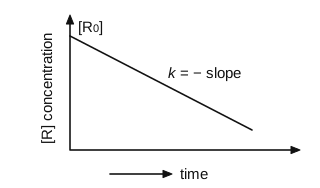
For a certain reaction R → Product, the plot of concentration [R] vs time has a negative slope as shown. The order of reaction is:
Answer
NTA's official answer key for NEET 2026 (3 May) is not in hand yet. This page will carry the answer when it is; we do not put an answer of our own in its place.
NEET 2026 (3 May) · Q88 · Activation energy from an expression for ln k
Given below is an expression for the rate constant of a first order reaction occurring at a certain temperature, T (K).
ln k = 14.34 − 1.25 × 10⁴T
The energy of activation in kcal mol-1 for the reaction is:
[Given: k in s-1, R = 1.987 cal mol-1 K-1]
ln k = 14.34 − 1.25 × 10⁴T
The energy of activation in kcal mol-1 for the reaction is:
[Given: k in s-1, R = 1.987 cal mol-1 K-1]
Answer
NTA's official answer key for NEET 2026 (3 May) is not in hand yet. This page will carry the answer when it is; we do not put an answer of our own in its place.
NEET 2025
NEET 2025 · Q49 · Time for a first-order reactant to fall to an eighth
If the rate constant of a reaction is 0.03 s-1, how much time does it take for 7.2 mol L-1 concentration of the reactant to get reduced to 0.9 mol L-1? (Given: log 2 = 0.301)
NTA's answer
Answer: (3) 69.3 s
From NTA's final answer key for NEET 2025.
NEET 2025 · Q73 · Time for 99.9% completion of a first-order reaction
If the half-life (t1/2) for a first order reaction is 1 minute, then the time required for 99.9% completion of the reaction is closest to:
NTA's answer
Answer: (2) 10 minutes
From NTA's final answer key for NEET 2025.
NEET 2024
NEET 2024 · Q72 · Plot of ln k against 1/T that fits the Arrhenius equation
Which plot of ln k vs 1T is consistent with Arrhenius equation?
Answer
NTA's official answer key for NEET 2024 is not in hand yet. This page will carry the answer when it is; we do not put an answer of our own in its place.
NEET 2024 · Q80 · Data needed to calculate activation energy
Activation energy of any chemical reaction be calculated if one knows the value of
Answer
NTA's official answer key for NEET 2024 is not in hand yet. This page will carry the answer when it is; we do not put an answer of our own in its place.
NEET 2024 · Q86 · Activation energy when the rate quadruples over a temperature rise
The rate of a reaction quadruples when temperature changes from 27 °C to 57 °C. Calculate the energy of activation.
Given: R = 8.314 J K-1 mol-1, log 4 = 0.6021
Given: R = 8.314 J K-1 mol-1, log 4 = 0.6021
Answer
NTA's official answer key for NEET 2024 is not in hand yet. This page will carry the answer when it is; we do not put an answer of our own in its place.
NEET 2023 (Manipur)
NEET 2023 (Manipur) · Q53 · Rate law with overall first order
The CORRECT option for the rate law that corresponds to overall first order reaction is:
NTA's answer
Answer: (2) Rate = k[A]–1/2 [B]3/2
From NTA's final answer key for NEET 2023 (Manipur).
NEET 2023 (Manipur) · Q81 · Rate of appearance of product against disappearance of reactant
For a reaction 3A → 2B
The average rate of appearance of B is given by Δ[B]Δt. The CORRECT relation between the average rate of appearance of B with the average rate of disappearance of A is given in option:
The average rate of appearance of B is given by Δ[B]Δt. The CORRECT relation between the average rate of appearance of B with the average rate of disappearance of A is given in option:
NTA's answer
Answer: (1) –2Δ[A]3Δt
From NTA's final answer key for NEET 2023 (Manipur).
NEET 2023
NEET 2023 · Q53 · Effect on rate of tripling one reactant's concentration
For a certain reaction, the rate = k[A]2[B], when the initial concentration of A is tripled keeping concentration of B constant, the initial rate would
NTA's answer
Answer: (2) increase by a factor of nine.
From NTA's final answer key for NEET 2023.
NEET 2023 · Q62 · Whether a reaction can have zero activation energy
Given below are two statements: one is labelled as Assertion A and the other is labelled as Reason R:
Assertion A: A reaction can have zero activation energy.
Reason R: The minimum extra amount of energy absorbed by reactant molecules so that their energy becomes equal to threshold value, is called activation energy.
In the light of the above statements, choose the CORRECT answer from the options given below:
NTA's answer
Answer: (3) A is false but R is true.
From NTA's final answer key for NEET 2023.
NEET 2022
NEET 2022 · Q82 · Axes of a horizontal-line graph for zero and first order reactions
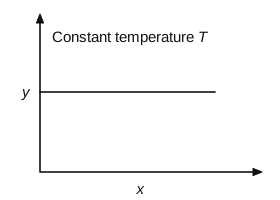
The given graph is a representation of kinetics of a reaction.
The y and x axes for zero and first order reactions, respectively are:
The y and x axes for zero and first order reactions, respectively are:
NTA's answer
Answer: (1) zero order (y = rate and x = concentration), first order (y = t½ and x = concentration)
From NTA's final answer key for NEET 2022.
NEET 2022 · Q99 · Rate constant of a first-order reaction from concentrations
For a first order reaction A → Products, initial concentration of A is 0.1 M, which becomes 0.001 M after 5 minutes. Rate constant for the reaction in min-1 is
NTA's answer
Answer: (4) 0.9212
From NTA's final answer key for NEET 2022.
NEET 2021
NEET 2021 · Q59 · Energy profile from enthalpy of reaction and of activation
For a reaction A→B, enthalpy of reaction is –4.2 kJ mol–1 and enthalpy of activation is 9.6 kJ mol–1. The CORRECT potential energy profile for the reaction is shown in option.
NTA's answer
Answer: (1)
From NTA's final answer key for NEET 2021.
NEET 2021 · Q87 · Activation energy from the slope of an Arrhenius plot
The slope of Arrhenius plot (ln k v/s 1T) of first order reaction is –5 × 10³K. The value of Ea of the reaction is _______. Choose the CORRECT option for answer.
[Given: R = 8.314 JK–1mol–1]
[Given: R = 8.314 JK–1mol–1]
NTA's answer
Answer: (4) 41.5 kJ mol–1
From NTA's final answer key for NEET 2021.
NEET 2020
NEET 2020 · Q138 · What changes when reactant concentration is raised
An increase in the concentration of the reactants of a reaction leads to change in ________.
Answer
NTA's official answer key for NEET 2020 is not in hand yet. This page will carry the answer when it is; we do not put an answer of our own in its place.
NEET 2020 · Q153 · Time for a first-order reactant to fall to a tenth
The rate constant for a first order reaction is 4.606 × 10⁻³ s-1. The time required to reduce 2.0 g of the reactant to 0.2 g is _______.
Answer
NTA's official answer key for NEET 2020 is not in hand yet. This page will carry the answer when it is; we do not put an answer of our own in its place.
NEET 2019 (Odisha)
NEET 2019 (Odisha) · Q56 · Time for a first-order reactant to fall to a quarter
A first order reaction has a rate constant of 2.303 × 10⁻³ s-1. The time required for 40 g of this reactant to reduce to 10 g will be _______.
[Given that log10 2 = 0.3010]
[Given that log10 2 = 0.3010]
Answer
NTA's official answer key for NEET 2019 (Odisha) is not in hand yet. This page will carry the answer when it is; we do not put an answer of our own in its place.
NEET 2019 (Odisha) · Q88 · Rate constant at another temperature when activation energy is zero
For a reaction, activation energy Ea = 0 and the rate constant at 200 K is 1.6 × 10⁶ s-1. The rate constant at 400 K will be _______.
[Given that gas constant, R = 8.314 J K-1 mol-1]
[Given that gas constant, R = 8.314 J K-1 mol-1]
Answer
NTA's official answer key for NEET 2019 (Odisha) is not in hand yet. This page will carry the answer when it is; we do not put an answer of our own in its place.
NEET 2019
NEET 2019 · Q48 · Rate expressions for ammonia synthesis
For the chemical reaction,
N2(g) + 3H2(g) ⇌ 2NH3(g)
the CORRECT option is ______.
N2(g) + 3H2(g) ⇌ 2NH3(g)
the CORRECT option is ______.
Answer
NTA's official answer key for NEET 2019 is not in hand yet. This page will carry the answer when it is; we do not put an answer of our own in its place.
NEET 2019 · Q77 · Time for 99% completion of a first-order reaction
If the rate constant for a first order reaction is k, the time (t) required for the completion of 99% of the reaction is given by ______.
Answer
NTA's official answer key for NEET 2019 is not in hand yet. This page will carry the answer when it is; we do not put an answer of our own in its place.
NEET 2018
NEET 2018 · Q65 · Difference between first- and second-order reactions
The CORRECT difference between first- and second-order reactions is that _______.
Answer
NTA's official answer key for NEET 2018 is not in hand yet. This page will carry the answer when it is; we do not put an answer of our own in its place.
NEET 2018 · Q86 · Half-life of a zero-order reaction on doubling concentration
When initial concentration of the reactant is doubled, the half-life period of a zero order reaction _______.
Answer
NTA's official answer key for NEET 2018 is not in hand yet. This page will carry the answer when it is; we do not put an answer of our own in its place.
NEET 2017
NEET 2017 · Q69 · Overall order from a mechanism with a slow step
Mechanism of a hypothetical reaction X2 + Y2 → 2XY is given below:
(i) X2 ⇌ X + X … fast
(ii) X + Y2 → XY + Y … slow
(iii) X + Y → XY … fast
The overall order of the reaction will be _______.
(i) X2 ⇌ X + X … fast
(ii) X + Y2 → XY + Y … slow
(iii) X + Y → XY … fast
The overall order of the reaction will be _______.
Answer
NTA's official answer key for NEET 2017 is not in hand yet. This page will carry the answer when it is; we do not put an answer of our own in its place.
NEET 2017 · Q74 · Time for a first-order reactant to fall to a quarter
A first order reaction has a specific reaction rate of 10-2 sec-1. How much time will it take for 20 g of the reactant to reduce to 5 g?
Answer
NTA's official answer key for NEET 2017 is not in hand yet. This page will carry the answer when it is; we do not put an answer of our own in its place.
NEET 2016 Phase II
NEET 2016 Phase II · Q67 · Order of phosphine decomposition on tungsten at low pressure
The decomposition of phosphine (PH3) on tungsten at low pressure is a first order reaction. It is because the ________.
Answer
NTA's official answer key for NEET 2016 Phase II is not in hand yet. This page will carry the answer when it is; we do not put an answer of our own in its place.
NEET 2016 Phase I
NEET 2016 Phase I · Q55 · Quantity altered by a catalyst
The addition of a catalyst during a chemical reaction alters which of the following quantities?
Answer
NTA's official answer key for NEET 2016 Phase I is not in hand yet. This page will carry the answer when it is; we do not put an answer of our own in its place.
NEET 2016 Phase I · Q63 · Half-life of a first-order reaction from two rates
The rate of a first-order reaction is 0.04 mol L-1 s-1 at 10 seconds and 0.03 mol L-1 s-1 at 20 seconds after initiation of the reaction. The half-life period of the reaction is _______.
Answer
NTA's official answer key for NEET 2016 Phase I is not in hand yet. This page will carry the answer when it is; we do not put an answer of our own in its place.
AIPMT 2015 Re-Test
AIPMT 2015 Re-Test · Q69 · Product concentration in a zero-order reaction
The rate constant of the reaction A → B is 0.6 × 10⁻³ M per second. If the concentration of A is 5 M, then concentration of B after 20 minutes is ______.
Answer
NTA's official answer key for AIPMT 2015 Re-Test is not in hand yet. This page will carry the answer when it is; we do not put an answer of our own in its place.
AIPMT 2015
AIPMT 2015 · Q58 · Order of reaction from half-life independent of concentration
When initial concentration of a reactant is doubled in a reaction, its half-life period is not affected. The order of the reaction is _______.
Answer
NTA's official answer key for AIPMT 2015 is not in hand yet. This page will carry the answer when it is; we do not put an answer of our own in its place.
AIPMT 2015 · Q76 · Graph that gives activation energy
The activation energy of a reaction can be determined from the slope of which of the following graphs?
Answer
NTA's official answer key for AIPMT 2015 is not in hand yet. This page will carry the answer when it is; we do not put an answer of our own in its place.