NEET Physics · Class 12 · 36 questions · 2014 to 2026
NEET Dual Nature of Radiation and Matter previous year questions
36 questions on Dual Nature of Radiation and Matter from 18 NEET and AIPMT papers, 2014 to 2026, newest first; on average 2.0 a paper. Open a question for NTA's official answer.
Answers are NTA's official final key, shown for NEET 2021, NEET 2022, NEET 2023, NEET 2023 (Manipur), NEET 2025 and NEET 2026 Re-Examination (21 June). The other papers are given without answers until NTA's key for them is in hand; we do not put an answer of our own in its place. The questions are from published copies of each paper, not from NTA's own booklets, so a word here and there may differ from the printed paper. Chapter-wise weightage
NEET 2026 Re-Examination (21 June) (3)NEET 2026 (3 May) (2)NEET 2025 (2)NEET 2024 (2)NEET 2023 (Manipur) (2)NEET 2023 (2)NEET 2022 (2)NEET 2021 (2)NEET 2020 (2)NEET 2019 (Odisha) (2)NEET 2019 (1)NEET 2018 (2)NEET 2017 (2)NEET 2016 Phase II (2)NEET 2016 Phase I (2)AIPMT 2015 Re-Test (2)AIPMT 2015 (2)AIPMT 2014 (2)
NEET 2026 Re-Examination (21 June)
NEET 2026 Re-Examination (21 June) · Q1 · Momentum ratio of an electron and a photon of equal energy
A photon and an electron, each of 20 eV energy, move in free space. The ratio of linear momentum of electron pe to that of photon pph, pepph is: (Take speed of light = 3 × 10⁸ ms-1, charge of electron = – 1.6 × 10⁻¹⁹ C and mass of electron = 9 × 10-31 kg)
NTA's answer
Answer: (4) 225
From NTA's final answer key for NEET 2026 Re-Examination (21 June).
NEET 2026 Re-Examination (21 June) · Q7 · Photocurrent and stopping potential as source power falls
A beam of light falls on a metal surface such that photo-electrons are generated. If power of the light source starts to decrease linearly with time t, then variation of the photocurrent I and magnitude of the stopping potential |V| with time is best represented by:
NTA's answer
Answer: (2)
From NTA's final answer key for NEET 2026 Re-Examination (21 June).
NEET 2026 Re-Examination (21 June) · Q39 · Stopping potentials of three photocells with different threshold wavelengths
A ray of light with wavelength λ is incident on three different photo-electric cells namely 1, 2 and 3. The threshold wavelength of these photo-electric cells are λ1, λ2 and λ3, respectively and the magnitude of stopping potentials of these cells are V1, V2 and V3, respectively. The relation between λ and threshold wavelengths are λ1 < λ, λ2 > λ and λ3 ≫ λ. The correct option is:
NTA's answer
Answer: (2) V1 = 0, V2 < V3
From NTA's final answer key for NEET 2026 Re-Examination (21 June).
NEET 2026 (3 May)
NEET 2026 (3 May) · Q2 · Matching relations and phenomena with particle and wave nature
Match List I with List II:
| List I | List II | ||
|---|---|---|---|
| i. | E = hv | a. | de Broglie wavelength |
| ii. | Diffraction and Interference | b. | Particle nature of light |
| iii. | λ = h/p | c. | Wave nature of light |
| iv. | Compton effect | d. | Energy of photon |
Choose the CORRECT answer from the options given below:
Answer
NTA's official answer key for NEET 2026 (3 May) is not in hand yet. This page will carry the answer when it is; we do not put an answer of our own in its place.
NEET 2026 (3 May) · Q42 · Wavelength that fails to cause photoelectric emission from a metal
For a metal of work function 6.6 eV, which of the following wavelengths of incident radiation does not give rise to the photoelectric effect?
(Take Planck’s constant as 6.6 × 10⁻³⁴ J s)
(Take Planck’s constant as 6.6 × 10⁻³⁴ J s)
Answer
NTA's official answer key for NEET 2026 (3 May) is not in hand yet. This page will carry the answer when it is; we do not put an answer of our own in its place.
NEET 2025
NEET 2025 · Q22 · Graphs of photoelectric current against properties of light
Which of the following options represent the variation of photoelectric current with property of light shown on the x-axis?
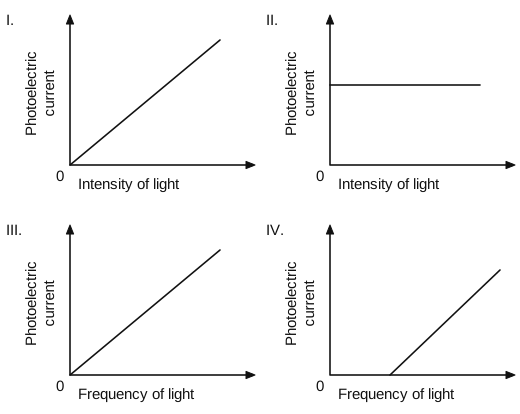
NTA's answer
Answer: (3) I only
From NTA's final answer key for NEET 2025.
NEET 2025 · Q35 · Ratio of wavelengths of a photon and an electron of equal energy
A photon and an electron (mass m) have the same energy E. The ratio (λphoton / λelectron) of their de Broglie wavelengths is: (c is the speed of light)
NTA's answer
Answer: (1) c√(2mE)
From NTA's final answer key for NEET 2025.
NEET 2024
NEET 2024 · Q5 · Correct statements about the photon
If c is the velocity of light in free space, the correct statements about photon among the following are:
I. The energy of a photon is E = hν.
II. The velocity of a photon is c.
III. The momentum of a photon, p = hνc
IV. In a photon-electron collision, both total energy and total momentum are conserved.
V. Photon possesses positive charge.
Choose the correct answer from the options given, below:
I. The energy of a photon is E = hν.
II. The velocity of a photon is c.
III. The momentum of a photon, p = hνc
IV. In a photon-electron collision, both total energy and total momentum are conserved.
V. Photon possesses positive charge.
Choose the correct answer from the options given, below:
Answer
NTA's official answer key for NEET 2024 is not in hand yet. This page will carry the answer when it is; we do not put an answer of our own in its place.
NEET 2024 · Q15 · Graph of inverse square of de Broglie wavelength against kinetic energy
The graph which shows the variation of (1λ2) and its kinetic energy, E is (where λ is de Broglie wavelength of a free particle):
Answer
NTA's official answer key for NEET 2024 is not in hand yet. This page will carry the answer when it is; we do not put an answer of our own in its place.
NEET 2023 (Manipur)
NEET 2023 (Manipur) · Q20 · Factor that does not affect maximum kinetic energy of photoelectrons
The maximum kinetic energy of the emitted photoelectrons in photoelectric effect is independent of:
NTA's answer
Answer: (4) intensity of incident radiation
From NTA's final answer key for NEET 2023 (Manipur).
NEET 2023 (Manipur) · Q25 · De Broglie wavelength of an electron accelerated through a potential
The de Broglie wavelength associated with an electron, accelerated by a potential difference of 81 V is given by:
NTA's answer
Answer: (2) 0.136 nm
From NTA's final answer key for NEET 2023 (Manipur).
NEET 2023
NEET 2023 · Q13 · Which metals emit photoelectrons for a given photon energy
The work functions of Caesium (Cs), Potassium (K) and Sodium (Na) are 2.14 eV, 2.30 eV and 2.75 eV respectively. If incident electromagnetic radiation has an incident energy of 2.20 eV, which of these photosensitive surfaces may emit photoelectrons?
NTA's answer
Answer: (4) Cs only
From NTA's final answer key for NEET 2023.
NEET 2023 · Q14 · Minimum X-ray wavelength and accelerating potential
The minimum wavelength of X-rays produced by an electron accelerated through a potential difference of V volts is proportional to:
NTA's answer
Answer: (1) 1V
From NTA's final answer key for NEET 2023.
NEET 2022
NEET 2022 · Q14 · Graph of de Broglie wavelength against momentum
The graph which shows the variation of the de Broglie wavelength (λ) of a particle and its associated momentum (p) is:
NTA's answer
Answer: (2)
From NTA's final answer key for NEET 2022.
NEET 2022 · Q29 · Threshold frequency from stopping potentials at two frequencies
When two monochromatic lights of frequency, ν and ν2 are incident on a photoelectric metal, their stopping potential becomes Vs2 and Vs respectively. The threshold frequency for this metal is:
NTA's answer
Answer: (2) 32 ν
From NTA's final answer key for NEET 2022.
NEET 2021
NEET 2021 · Q20 · Photons emitted per second by a monochromatic source
The number of photons per second on an average emitted by the source of monochromatic light of wavelength 600 nm, when it delivers the power 3.3 × 10⁻³ watt will be: (h = 6.6 × 10⁻³⁴ Js)
NTA's answer
Answer: (2) 1016
From NTA's final answer key for NEET 2021.
NEET 2021 · Q31 · Relation between incident wavelength and photoelectron's de Broglie wavelength
An electromagnetic wave of wavelength 'λ' is incident on a photosensitive surface of negligible work function. If 'm' mass is of photoelectron emitted from the surface has de-Broglie wavelength λd then:
NTA's answer
Answer: (2) λ = (2mch) λd2
From NTA's final answer key for NEET 2021.
NEET 2020
NEET 2020 · Q118 · Photoelectric current when frequency is halved and intensity doubled
Light of frequency 1.5 times the threshold frequency is incident on a photosensitive material. What will be the photoelectric current if the frequency is halved and intensity is doubled?
Answer
NTA's official answer key for NEET 2020 is not in hand yet. This page will carry the answer when it is; we do not put an answer of our own in its place.
NEET 2020 · Q129 · Accelerating potential from an electron's de Broglie wavelength
An electron is accelerated from rest through a potential difference of V volt. If the de Broglie wavelength of the electron is 1.227 × 10⁻² nm, the potential difference is:
Answer
NTA's official answer key for NEET 2020 is not in hand yet. This page will carry the answer when it is; we do not put an answer of our own in its place.
NEET 2019 (Odisha)
NEET 2019 (Odisha) · Q35 · Longest wavelength that causes photoemission
The work function of a photosensitive material is 4.0 eV. The longest wavelength of light that can cause photon emission from the substance is (approximately)
Answer
NTA's official answer key for NEET 2019 (Odisha) is not in hand yet. This page will carry the answer when it is; we do not put an answer of our own in its place.
NEET 2019 (Odisha) · Q37 · Ratio of de Broglie wavelengths of a proton and an alpha particle
A proton and an α-particle are accelerated from rest to the same energy. The de Broglie wavelengths λp and λα are in the ratio,
Answer
NTA's official answer key for NEET 2019 (Odisha) is not in hand yet. This page will carry the answer when it is; we do not put an answer of our own in its place.
NEET 2019
NEET 2019 · Q16 · de Broglie wavelength of an electron accelerated through a potential
An electron is accelerated through a potential difference of 10,000 V. Its de Broglie wavelength is, (nearly) (me = 9 × 10-31 kg)
Answer
NTA's official answer key for NEET 2019 is not in hand yet. This page will carry the answer when it is; we do not put an answer of our own in its place.
NEET 2018
NEET 2018 · Q1 · de Broglie wavelength of an electron accelerating in an electric field
An electron of mass m with an initial velocity v = v0 î (v0 > 0) enters an electric field E = –E0 î (E0 = constant > 0) at t = 0. If λ0 is its de-Broglie wavelength at time t is
Answer
NTA's official answer key for NEET 2018 is not in hand yet. This page will carry the answer when it is; we do not put an answer of our own in its place.
NEET 2018 · Q34 · Ratio of maximum photoelectron speeds at two frequencies
When the light of frequency 2ν0 (where ν0 is threshold frequency), is incident on a metal plate, then the maximum velocity of electrons emitted is v1. When the frequency of the incident radiation is increased to 5ν0, the maximum velocity of electrons emitted from the same plate is v2. The ratio of v1 to v2 is
Answer
NTA's official answer key for NEET 2018 is not in hand yet. This page will carry the answer when it is; we do not put an answer of our own in its place.
NEET 2017
NEET 2017 · Q15 · Speed of a photoelectron from threshold and incident wavelengths
The photoelectric threshold wavelength of silver is 3250 × 10-10 m. The velocity of the electron ejected from a silver surface by ultraviolet light of wavelength 2536 × 10-10 m is:
(Given: h = 4.14 × 10⁻¹⁵ eVs and c = 3 × 10⁸ ms-1)
(Given: h = 4.14 × 10⁻¹⁵ eVs and c = 3 × 10⁸ ms-1)
Answer
NTA's official answer key for NEET 2017 is not in hand yet. This page will carry the answer when it is; we do not put an answer of our own in its place.
NEET 2017 · Q42 · de Broglie wavelength of a thermal neutron
The de-Broglie wavelength of a neutron in thermal equilibrium with heavy water at a temperature T (Kelvin) and mass m, is:
Answer
NTA's official answer key for NEET 2017 is not in hand yet. This page will carry the answer when it is; we do not put an answer of our own in its place.
NEET 2016 Phase II
NEET 2016 Phase II · Q1 · Stopping potential in a photoelectric cell
Photons with energy 5 eV are incident on a cathode C in a photoelectric cell. The maximum energy of emitted photoelectrons is 2 eV. When photons of energy 6 eV are incident on C, no photoelectrons will reach the anode A, if the stopping potential of A relative to C is
Answer
NTA's official answer key for NEET 2016 Phase II is not in hand yet. This page will carry the answer when it is; we do not put an answer of our own in its place.
NEET 2016 Phase II · Q41 · Cut-off X-ray wavelength from the electron's de Broglie wavelength
Electrons of mass m with de-Broglie wavelength λ fall on the target in an X-ray tube. The cut-off wavelength (λ0) of the emitted X-ray is
Answer
NTA's official answer key for NEET 2016 Phase II is not in hand yet. This page will carry the answer when it is; we do not put an answer of our own in its place.
NEET 2016 Phase I
NEET 2016 Phase I · Q30 · Ratio of de Broglie wavelengths of an electron and a photon
An electron of mass m and a photon have same energy E. The ratio of de-Broglie wavelengths associated with them is (c being velocity of light)
Answer
NTA's official answer key for NEET 2016 Phase I is not in hand yet. This page will carry the answer when it is; we do not put an answer of our own in its place.
NEET 2016 Phase I · Q35 · Threshold wavelength from stopping potentials at two wavelengths
When a metallic surface is illuminated with radiation of wavelength λ, the stopping potential is V. If the same surface is illuminated with radiation of wavelength 2λ, the stopping potential is V4. The threshold wavelength for metallic surface is
Answer
NTA's official answer key for NEET 2016 Phase I is not in hand yet. This page will carry the answer when it is; we do not put an answer of our own in its place.
AIPMT 2015 Re-Test
AIPMT 2015 Re-Test · Q37 · de Broglie wavelength of an emitted photoelectron
Light of wavelength 500 nm is incident on a metal with work function 2.28 eV. The de Broglie wavelength of the emitted electron is:
Answer
NTA's official answer key for AIPMT 2015 Re-Test is not in hand yet. This page will carry the answer when it is; we do not put an answer of our own in its place.
AIPMT 2015 Re-Test · Q44 · Work function from kinetic energies at two wavelengths
A photoelectric surface is illuminated successively by monochromatic light of wavelength λ and λ2. If the maximum kinetic energy of the emitted photoelectrons in the second case is 3 times that in the first case, the work function of the surface of the material is: (h = Planck's constant, c = speed of light)
Answer
NTA's official answer key for AIPMT 2015 Re-Test is not in hand yet. This page will carry the answer when it is; we do not put an answer of our own in its place.
AIPMT 2015
AIPMT 2015 · Q2 · Graph of de Broglie wavelength against momentum
Which of the following figures represent the variation of particle momentum and the associated de-Broglie wavelength?
Answer
NTA's official answer key for AIPMT 2015 is not in hand yet. This page will carry the answer when it is; we do not put an answer of our own in its place.
AIPMT 2015 · Q37 · Threshold wavelength from stopping potentials at two wavelengths
A certain metallic surface is illuminated with monochromatic light of wavelength λ. The stopping potential for photo-electric current for this light is 3V0. If the same surface is illuminated with light of wavelength 2λ, the stopping potential is V0. The threshold wavelength for this surface for photoelectric effect is
Answer
NTA's official answer key for AIPMT 2015 is not in hand yet. This page will carry the answer when it is; we do not put an answer of our own in its place.
AIPMT 2014
AIPMT 2014 · Q13 · Work function from photoelectron energies at two photon energies
When the energy of the incident radiation is increased by 20%, the kinetic energy of the photoelectrons emitted from a metal surface increased from 0.5 eV to 0.8 eV. The work function of the metal is
Answer
NTA's official answer key for AIPMT 2014 is not in hand yet. This page will carry the answer when it is; we do not put an answer of our own in its place.
AIPMT 2014 · Q45 · Change in de Broglie wavelength when kinetic energy increases
If the kinetic energy of the particle is increased to 16 times its previous value, the percentage change in the de-Broglie wavelength of the particle is
Answer
NTA's official answer key for AIPMT 2014 is not in hand yet. This page will carry the answer when it is; we do not put an answer of our own in its place.