NEET Physics · Class 12 · 46 questions · 2014 to 2026

NEET Ray Optics and Optical Instruments previous year questions

46 questions on Ray Optics and Optical Instruments from 18 NEET and AIPMT papers, 2014 to 2026, newest first; on average 2.6 a paper. Open a question for NTA's official answer.

Answers are NTA's official final key, shown for NEET 2021, NEET 2022, NEET 2023, NEET 2023 (Manipur), NEET 2025 and NEET 2026 Re-Examination (21 June). The other papers are given without answers until NTA's key for them is in hand; we do not put an answer of our own in its place. The questions are from published copies of each paper, not from NTA's own booklets, so a word here and there may differ from the printed paper. Chapter-wise weightage

NEET 2026 Re-Examination (21 June) (3)NEET 2026 (3 May) (2)NEET 2025 (2)NEET 2024 (2)NEET 2023 (Manipur) (4)NEET 2023 (3)NEET 2022 (3)NEET 2021 (4)NEET 2020 (1)NEET 2019 (Odisha) (2)NEET 2019 (3)NEET 2018 (3)NEET 2017 (2)NEET 2016 Phase II (3)NEET 2016 Phase I (3)AIPMT 2015 Re-Test (2)AIPMT 2015 (2)AIPMT 2014 (2)
NEET 2026 Re-Examination (21 June)

NEET 2026 Re-Examination (21 June) · Q24 · Apparent positions of an object seen through layered media
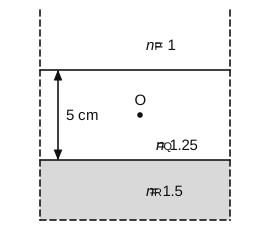
Consider three media P,Q and R with refractive indices 1, 1.25, and 1.5, respectively. The medium Q having a thickness of 5cm is placed between extended media P and R as shown in the figure. An object O is placed at the center of medium Q. If viewed from medium P near the normal direction, the apparent depth of O is h1. For similar observation from medium R, the apparent depth is h2. The value of |h1 – h2|, in cm, is:
Three horizontal media between dashed side lines: medium P on top with n_P = 1; a 5 cm thick layer Q in the middle with n_Q = 1.25 and an object O (a dot) at its centre; and the shaded medium R below with n_R = 1.5.
NTA's answer

Answer: (3) 1

From NTA's final answer key for NEET 2026 Re-Examination (21 June).
NEET 2026 Re-Examination (21 June) · Q29 · Image position for a convex and concave lens combination
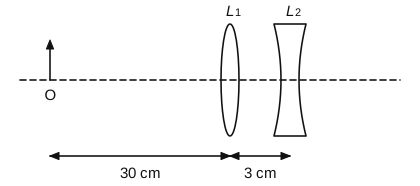
The lens combination as shown in the figure, consists of two lenses, L1 and L2, of the focal lengths + 10cm and – 10cm, respectively. The position of the image formed is:
On a dashed principal axis: an object O (an upward arrow) on the left, a convex lens L1 30 cm to its right, and a concave lens L2 3 cm to the right of L1.
NTA's answer

Answer: (3) 60cm to the left of the concave lens

From NTA's final answer key for NEET 2026 Re-Examination (21 June).

NEET 2026 Re-Examination (21 June) · Q36 · Experiment that requires an index correction
Which of the following measurements require 'index correction'?
NTA's answer

Answer: (4) Measurement of focal length of lenses using optical bench

From NTA's final answer key for NEET 2026 Re-Examination (21 June).

NEET 2026 (3 May)

NEET 2026 (3 May) · Q19 · Path of a ray parallel to the axis through a concave lens
In a concave lens, a ray of light emanating from the object parallel to the principal axis of the lens, after refraction:
Answer

NTA's official answer key for NEET 2026 (3 May) is not in hand yet. This page will carry the answer when it is; we do not put an answer of our own in its place.
NEET 2026 (3 May) · Q23 · Angle of deviation for a ray through an equilateral prism
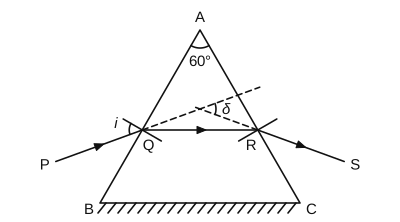
A ray of monochromatic light is passing through an equilateral prism (ABC) as shown in the figure. The refracted ray (QR) is parallel to its base (BC) and the angle of incidence (i) is 50°. Then the angle of deviation (δ) is:
Equilateral prism ABC, apex A (60° marked) at the top and base BC hatched; ray PQ from the lower left meets face AB at Q with angle of incidence i from the normal; QR runs inside parallel to BC; RS leaves face AC towards the lower right; PQ produced forward and RS produced backward (dashed) meet above QR, the angle between them marked δ.
Answer

NTA's official answer key for NEET 2026 (3 May) is not in hand yet. This page will carry the answer when it is; we do not put an answer of our own in its place.

NEET 2025

NEET 2025 · Q13 · Magnification of a compound microscope
A microscope has an objective of focal length 2 cm, eyepiece of focal length 4 cm and the tube length of 40 cm. If the distance of distinct vision of eye is 25 cm, the magnification in the microscope is
NTA's answer

Answer: (4) 125

From NTA's final answer key for NEET 2025.

NEET 2025 · Q27 · Power and magnification of four thin lenses in contact
In a certain camera, a combination of four similar thin convex lenses are arranged axially in contact. Then the power of the combination and the total magnification in comparison to the power (p) and magnification (m) for each lens will be, respectively –
NTA's answer

Answer: (1) 4p and m4

From NTA's final answer key for NEET 2025.

NEET 2024
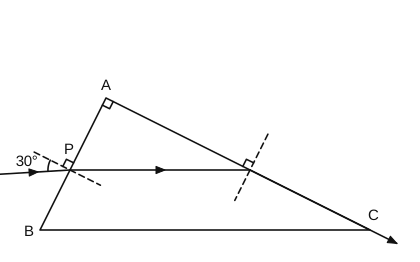
NEET 2024 · Q12 · Refractive index of a right-angled prism from the ray path
A light ray enters through a right angled prism at point P with the angle of incidence 30° as shown in figure. It travels through the prism parallel to its base BC and emerges along the face AC. The refractive index of the prism is:
A right-angled prism ABC, right angle at the top vertex A, base BC horizontal. A ray strikes face AB at point P at 30° to the dashed normal there, travels inside parallel to BC to face AC, and leaves grazing along AC towards C. Right-angle marks at A and where each dashed normal meets its face.
Answer

NTA's official answer key for NEET 2024 is not in hand yet. This page will carry the answer when it is; we do not put an answer of our own in its place.

NEET 2024 · Q42 · Magnifying power of a telescope
A small telescope has an objective of focal length 140 cm and an eye piece of focal length 5.0 cm. The magnifying power of telescope for viewing a distant object is:
Answer

NTA's official answer key for NEET 2024 is not in hand yet. This page will carry the answer when it is; we do not put an answer of our own in its place.

NEET 2023 (Manipur)
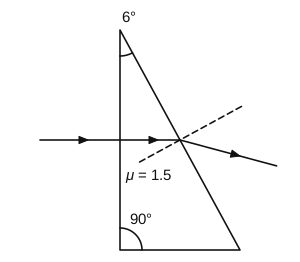
NEET 2023 (Manipur) · Q18 · Angle of emergence from a thin right-angled prism
A horizontal ray of light is incident on the right-angled prism with prism angle 6°. If the refractive index of the material of the prism is 1.5, then the angle of emergence will be:
A right-angled prism with a vertical left face: the angle at the top vertex is 6° and the angle at the bottom-left corner is 90°. A horizontal ray enters the left face, meets the slanting face and emerges bent downward, away from a dashed normal drawn at that point; μ = 1.5 is written inside the prism.
NTA's answer

Answer: (3) 9°

From NTA's final answer key for NEET 2023 (Manipur).
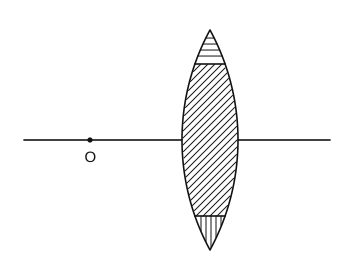
NEET 2023 (Manipur) · Q30 · Number of images formed by a lens made of three media
A lens is made up of 3 different transparent media as shown in figure. A point object O is placed on its axis beyond 2f. How many real images will be obtained on the other side?
A biconvex lens standing upright on a horizontal principal axis, divided by two horizontal lines into three media: a small top cap shaded with horizontal lines, a large middle part containing the axis shaded with diagonal lines, and a small bottom cap shaded with vertical lines; a point object O on the axis to the left.
NTA's answer

Answer: (2) 3

From NTA's final answer key for NEET 2023 (Manipur).
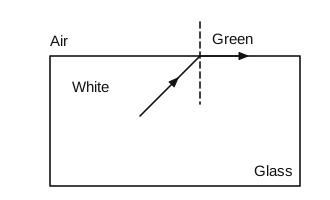
NEET 2023 (Manipur) · Q34 · Colours that emerge into air at a glass-air surface
Which set of colours will come out in air for a situation shown in figure?
A glass block with air above its top surface: a ray of white light travels up inside the glass to a point on the top surface, where a dashed normal is drawn; the green ray leaves that point along the surface to the right, labelled Green.
NTA's answer

Answer: (3) Yellow, Orange and Red

From NTA's final answer key for NEET 2023 (Manipur).

NEET 2023 (Manipur) · Q39 · Focal length of a lens giving an equal-size image between two walls
An object is mounted on a wall. Its image of equal size is to be obtained on a parallel wall with the help of a convex lens placed between these walls. The lens is kept at distance x in front of the second wall. The required focal length of the lens will be:
NTA's answer

Answer: (1) x2

From NTA's final answer key for NEET 2023 (Manipur).

NEET 2023

NEET 2023 · Q16 · Critical angle of a medium from travel times of light
Light travels a distance x in time t1 in air and 10x in time t2 in another denser medium. What is the critical angle for this medium?
NTA's answer

Answer: (3) sin-1(10t1t2)

From NTA's final answer key for NEET 2023.
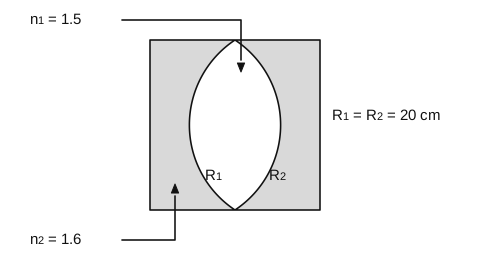
NEET 2023 · Q36 · Equivalent focal length of a layered lens combination
In the figure shown here, what is the equivalent focal length of the combination of lenses (Assume that all layers are thin)?
A square block of liquid of refractive index n2 = 1.6 (shaded) with a biconvex lens-shaped region of index n1 = 1.5 in its middle, its tips touching the top and bottom faces; the left face is R1 and the right face R2, with R1 = R2 = 20 cm.
NTA's answer

Answer: (2) –100 cm

From NTA's final answer key for NEET 2023.

NEET 2023 · Q42 · Focal length of a convex and a concave lens in contact
Two thin lenses are of same focal lengths (f), but one is convex and the other one is concave. When they are placed in contact with each other, the equivalent focal length of the combination will be:
NTA's answer

Answer: (3) Infinite

From NTA's final answer key for NEET 2023.

NEET 2022

NEET 2022 · Q16 · Angle between reflected and refracted rays at a glass surface
A light ray falls on a glass surface of refractive index √3, at an angle 60°. The angle between the refracted and reflected rays would be:
NTA's answer

Answer: (1) 90°

From NTA's final answer key for NEET 2022.

NEET 2022 · Q28 · Power of a biconvex lens from radii and refractive index
A biconvex lens has radii of curvature, 20 cm each. If the refractive index of the material of the lens is 1.5, the power of the lens is:
NTA's answer

Answer: (1) +5D

From NTA's final answer key for NEET 2022.

NEET 2022 · Q49 · Critical angle from speeds of light in two media
Two transparent media A and B are separated by a plane boundary. The speed of light in those media are 1.5 × 10⁸ m/s and 2.0 × 10⁸ m/s, respectively. The critical angle for a ray of light for these two media is:
NTA's answer

Answer: (4) sin-1 (0.750)

From NTA's final answer key for NEET 2022.

NEET 2021

NEET 2021 · Q9 · Why a telescope objective has large focal length and aperture
A lens of large focal length and large aperture is best suited as an objective of an astronomical telescope since:
NTA's answer

Answer: (4) all of the above.

From NTA's final answer key for NEET 2021.
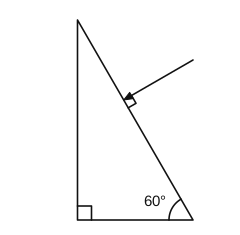
NEET 2021 · Q23 · Angle of emergence of a ray from a prism
Find the value of the angle of emergence from the prism. Refractive index of the glass is √3.
A right-angled triangular prism: right angle at the bottom left, 60° at the bottom right; a ray from the upper right falls on the slanting face along its normal (a right-angle mark at the point of incidence).
NTA's answer

Answer: (4) 60°

From NTA's final answer key for NEET 2021.
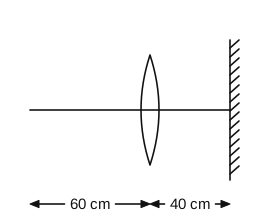
NEET 2021 · Q25 · Separation of convex and concave lenses for a parallel emergent beam
A convex lens 'A' of focal length 20 cm and a concave lens 'B' of focal length 5 cm are kept along the same axis with a distance 'd' between them. If a parallel beam of light falling on 'A' leaves 'B' as a parallel beam, then the distance 'd' in cm will be:
NTA's answer

Answer: (1) 15

From NTA's final answer key for NEET 2021.

NEET 2021 · Q39 · Final image for a convex lens with a plane mirror behind it
A point object is placed at a distance of 60 cm from a convex lens of focal length 30 cm. If a plane mirror were put perpendicular to the principal axis of the lens and at a distance of 40 cm from it, the final image would be formed at a distance of:
A principal axis through a convex lens and up to a plane mirror perpendicular to it (silvered side hatched on the right); below, 60 cm marked from the object position at the left end of the axis to the lens, and 40 cm from the lens to the mirror.
NTA's answer

Answer: (3) 20 cm from the plane mirror, it would be a virtual image.

From NTA's final answer key for NEET 2021.

NEET 2020

NEET 2020 · Q122 · Angle of incidence on a thin prism for normal emergence
A ray is incident at an angle of incidence i on one surface of a small angle prism (with angle of prism A) and emerges normally from the opposite surface. If the refractive index of the material of the prism is μ, then the angle of incidence is nearly equal to:
Answer

NTA's official answer key for NEET 2020 is not in hand yet. This page will carry the answer when it is; we do not put an answer of our own in its place.

NEET 2019 (Odisha)

NEET 2019 (Odisha) · Q31 · Radii of curvature of a double convex lens
A double convex lens has focal length 25 cm. The radius of curvature of one of the surfaces is double of the other. Find the radii if the refractive index of the material of the lens is 1.5.
Answer

NTA's official answer key for NEET 2019 (Odisha) is not in hand yet. This page will carry the answer when it is; we do not put an answer of our own in its place.

NEET 2019 (Odisha) · Q45 · Power of half an equiconvex lens cut along the principal axis
An equiconvex lens has power P. It is cut into two symmetrical halves by a plane containing the principal axis. The power of one part will be,
Answer

NTA's official answer key for NEET 2019 (Odisha) is not in hand yet. This page will carry the answer when it is; we do not put an answer of our own in its place.

NEET 2019

NEET 2019 · Q13 · Statements about the formation of a rainbow
Pick the wrong answer in the context with rainbow.
Answer

NTA's official answer key for NEET 2019 is not in hand yet. This page will carry the answer when it is; we do not put an answer of our own in its place.

NEET 2019 · Q18 · Angle of refraction at the critical angle
In total internal reflection when the angle of incidence is equal to the critical angle for the pair of media in contact, what will be angle of refraction?
Answer

NTA's official answer key for NEET 2019 is not in hand yet. This page will carry the answer when it is; we do not put an answer of our own in its place.

NEET 2019 · Q38 · Focal length of two lenses with glycerin between
Two similar thin equiconvex lenses, of focal length f each, are kept coaxially in contact with each other such that the focal length of the combination is F1. When the space between the two lenses is filled with glycerin (which has the same refractive index (μ = 1.5) as that of glass) then the equivalent focal length is F2. The ratio F1 : F2 will be:
Answer

NTA's official answer key for NEET 2019 is not in hand yet. This page will carry the answer when it is; we do not put an answer of our own in its place.

NEET 2018

NEET 2018 · Q28 · Displacement of the image in a concave mirror
An object is placed at a distance of 40 cm from concave mirror of focal length 15 cm. If the object is displaced through a distance of 20 cm towards the mirror, the displacement of the image will be
Answer

NTA's official answer key for NEET 2018 is not in hand yet. This page will carry the answer when it is; we do not put an answer of our own in its place.

NEET 2018 · Q32 · Angle of incidence for a ray retracing its path in a silvered prism
The refractive index of the material of a prism is √2 and the angle of the prism is 30°. One of the two refracting surfaces of the prism is made a mirror inwards, by silver coating. A beam of monochromatic light entering the prism from the other face will retrace its path (after reflection from the silvered surface) if its angle of incidence on the prism is
Answer

NTA's official answer key for NEET 2018 is not in hand yet. This page will carry the answer when it is; we do not put an answer of our own in its place.

NEET 2018 · Q45 · Objective lens for high magnification and resolution of a telescope
An astronomical refracting telescope will have large angular magnification and high angular resolution, when it has an objective lens of
Answer

NTA's official answer key for NEET 2018 is not in hand yet. This page will carry the answer when it is; we do not put an answer of our own in its place.

NEET 2017

NEET 2017 · Q26 · Deflection of a reflected spot when a mirror is rotated
A beam of light from a source L is incident normally on a plane mirror fixed at a certain distance x from the source. The beam is reflected back as a spot on a scale placed just above the source L. When the mirror is rotated through a small angle θ, the spot of the light is found to move through a distance y on the scale. The angle θ is given by
Answer

NTA's official answer key for NEET 2017 is not in hand yet. This page will carry the answer when it is; we do not put an answer of our own in its place.

NEET 2017 · Q36 · Angle of a second prism for dispersion without deviation
A thin prism having refracting angle 10° is made of glass of refractive index 1.42. This prism is combined with another thin prism of glass of refractive index 1.7. This combination produces dispersion without deviation. The refracting angle of second prism should be
Answer

NTA's official answer key for NEET 2017 is not in hand yet. This page will carry the answer when it is; we do not put an answer of our own in its place.

NEET 2016 Phase II

NEET 2016 Phase II · Q3 · Correcting lens for a defect of vision
A person can see clearly objects only when they lie between 50 cm and 400 cm from his eyes. In order to increase the maximum distance of distinct vision to infinity, the type and power of the correcting lens, the person has to use, will be
Answer

NTA's official answer key for NEET 2016 Phase II is not in hand yet. This page will carry the answer when it is; we do not put an answer of our own in its place.

NEET 2016 Phase II · Q30 · Focal length of two lenses with water between
Two identical glass (μg = 3/2) equiconvex lenses of focal length f each are kept in contact. The space between the two lenses is filled with water (μw = 4/3). The focal length of the combination is
Answer

NTA's official answer key for NEET 2016 Phase II is not in hand yet. This page will carry the answer when it is; we do not put an answer of our own in its place.

NEET 2016 Phase II · Q42 · Thickness of a slab from apparent depths of a bubble
An air bubble in a glass slab with refractive index 1.5 (near normal incidence) is 5 cm deep when viewed from one surface and 3 cm deep when viewed from the opposite face. The thickness (in cm) of the slab is
Answer

NTA's official answer key for NEET 2016 Phase II is not in hand yet. This page will carry the answer when it is; we do not put an answer of our own in its place.

NEET 2016 Phase I

NEET 2016 Phase I · Q3 · Minimum deviation and refractive index of a prism
The angle of incidence for a ray of light at a refracting surface of a prism is 45°. The angle of prism is 60°. If the ray suffers minimum deviation through the prism, the angle of minimum deviation and refractive index of the material of the prism respectively, are
Answer

NTA's official answer key for NEET 2016 Phase I is not in hand yet. This page will carry the answer when it is; we do not put an answer of our own in its place.

NEET 2016 Phase I · Q24 · Matching magnification values with mirror and image type
Match the corresponding entries of column–I with column–II (Where m is the magnification produced by the mirror)
Column – IColumn – II
i.m = – 2a.Convex mirror
ii.m = – 12b.Concave mirror
iii.m = +2c.Real image
iv.m = + 12d.Virtual image
Answer

NTA's official answer key for NEET 2016 Phase I is not in hand yet. This page will carry the answer when it is; we do not put an answer of our own in its place.

NEET 2016 Phase I · Q45 · Lens separation in a telescope viewing a near object
A astronomical telescope has objective and eyepiece of focal length 40 cm and 4 cm respectively. To view an object 200 cm away from the objective, the lenses must be separated by a distance
Answer

NTA's official answer key for NEET 2016 Phase I is not in hand yet. This page will carry the answer when it is; we do not put an answer of our own in its place.

AIPMT 2015 Re-Test

AIPMT 2015 Re-Test · Q25 · Separation of colours by total internal reflection in a prism
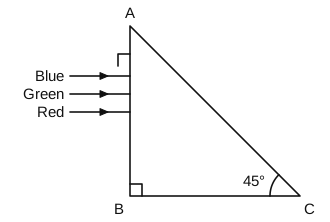
A beam of light consisting of red, green and blue colours is incident on a right angled prism. The refractive index of the material of the prism for the above red, green and blue wavelengths are 1.39, 1.44 and 1.47 respectively.

The prism will:
A right-angled prism ABC: AB vertical (A at the top, B at the bottom), BC horizontal with C on the right, the right angle at B and the angle at C marked 45°. Three parallel horizontal rays, labelled from the top Blue, Green and Red, come from the left and strike face AB normally (right-angle mark at AB).
Answer

NTA's official answer key for AIPMT 2015 Re-Test is not in hand yet. This page will carry the answer when it is; we do not put an answer of our own in its place.

AIPMT 2015 Re-Test · Q33 · Magnification of an astronomical telescope from an image of the objective
In an astronomical telescope in normal adjustment a straight black line of length L is drawn on inside part of objective lens. The eye-piece forms real image of this line. The length of this image is I. the magnification of the telescope
Answer

NTA's official answer key for AIPMT 2015 Re-Test is not in hand yet. This page will carry the answer when it is; we do not put an answer of our own in its place.

AIPMT 2015

AIPMT 2015 · Q5 · Focal length of two plano-convex lenses with oil between
Two identical thin plano-convex glass lenses (refractive index 1.5) each having radius of curvature of 20 cm are placed with their convex surfaces in contact at the centre. The intervening space is filled with oil of refractive index 1.7. The focal length of the combination is
Answer

NTA's official answer key for AIPMT 2015 is not in hand yet. This page will carry the answer when it is; we do not put an answer of our own in its place.

AIPMT 2015 · Q31 · Angle of minimum deviation of a prism
The refracting angle of a prism is A, and refractive index of the material of the prism is cot(A/2). The angle of minimum deviation is
Answer

NTA's official answer key for AIPMT 2015 is not in hand yet. This page will carry the answer when it is; we do not put an answer of our own in its place.

AIPMT 2014

AIPMT 2014 · Q16 · Effect of objective focal length on magnifying power of microscope and telescope
If the focal length of objective lens is increased then magnifying power of
Answer

NTA's official answer key for AIPMT 2014 is not in hand yet. This page will carry the answer when it is; we do not put an answer of our own in its place.

AIPMT 2014 · Q31 · Refractive index of a prism with one silvered face
The angle of a prism is A. One of its refracting surfaces is silvered. Light rays falling at an angle of incidence 2A on the first surface returns back through the same path after suffering reflection at the silvered surface. The refractive index μ, of the prism is
Answer

NTA's official answer key for AIPMT 2014 is not in hand yet. This page will carry the answer when it is; we do not put an answer of our own in its place.

Free NEET chapter practice and testsSee the Class 12 flashcards

← Electromagnetic WavesWave Optics →