NEET Physics · Class 11 · 27 questions · 2014 to 2026

NEET Thermodynamics previous year questions

27 questions on Thermodynamics from 18 NEET and AIPMT papers, 2014 to 2026, newest first; on average 1.5 a paper. Open a question for NTA's official answer.

Answers are NTA's official final key, shown for NEET 2021, NEET 2022, NEET 2023, NEET 2023 (Manipur), NEET 2025 and NEET 2026 Re-Examination (21 June). The other papers are given without answers until NTA's key for them is in hand; we do not put an answer of our own in its place. The questions are from published copies of each paper, not from NTA's own booklets, so a word here and there may differ from the printed paper. Chapter-wise weightage

NEET 2026 Re-Examination (21 June) (2)NEET 2026 (3 May) (1)NEET 2025 (1)NEET 2024 (1)NEET 2023 (Manipur) (1)NEET 2023 (1)NEET 2022 (1)NEET 2020 (1)NEET 2019 (Odisha) (1)NEET 2019 (1)NEET 2018 (3)NEET 2017 (2)NEET 2016 Phase II (2)NEET 2016 Phase I (2)AIPMT 2015 Re-Test (2)AIPMT 2015 (3)AIPMT 2014 (2)

NEET 2026 Re-Examination (21 June)

NEET 2026 Re-Examination (21 June) · Q15 · Work done by a monatomic gas in an adiabatic expansion
In an adiabatic expansion, the temperature of one mole of an ideal monatomic gas (γ = 5/3) decreases from 60 K to 50 K. The work done by the gas in the process is:(Take the universal gas constant as R = 8.3 J mol-1 K-1)
NTA's answer

Answer: (4) 124.5 J

From NTA's final answer key for NEET 2026 Re-Examination (21 June).
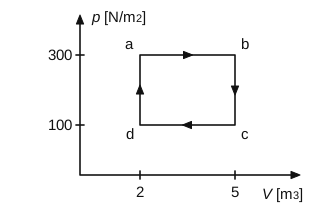
NEET 2026 Re-Examination (21 June) · Q43 · Total heat supplied in a cyclic process of a monatomic gas
One mole of an ideal monatomic gas undergoes a cyclic process as shown in the figure. The total heat supplied to the gas is:
A p–V diagram, p in N/m² (marks 100 and 300) against V in m³ (marks 2 and 5): a rectangle a (2, 300) → b (5, 300) → c (5, 100) → d (2, 100) → a, traversed clockwise, with arrows to the right along the top, down the right side, to the left along the bottom and up the left side.
NTA's answer

Answer: (4) 600 J

From NTA's final answer key for NEET 2026 Re-Examination (21 June).

NEET 2026 (3 May)

NEET 2026 (3 May) · Q28 · Rate of increase of internal energy from heat supplied and work done
An electric heater supplies heat to a system at a rate of 100 W. If the system performs work at a rate of 75 J/s, then the rate at which internal energy increases will be:
Answer

NTA's official answer key for NEET 2026 (3 May) is not in hand yet. This page will carry the answer when it is; we do not put an answer of our own in its place.

NEET 2025

NEET 2025 · Q28 · Piston displacements of two gases heated at constant pressure
Two gases A and B are filled at the same pressure in separate cylinders with movable pistons of radius rA and rB, respectively. On supplying an equal amount of heat to both the systems reversibly under constant pressure, the pistons of gas A and B are displaced by 16 cm and 9 cm, respectively. If the change in their internal energy is the same, then the ratio rArB is equal to
NTA's answer

Answer: (4) 34

From NTA's final answer key for NEET 2025.

NEET 2024
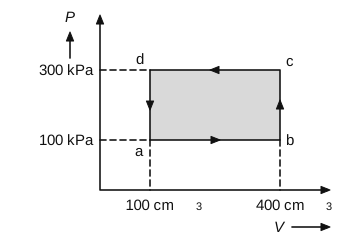
NEET 2024 · Q8 · Work done along one path of a thermodynamic cycle
A thermodynamic system is taken through the cycle abcda. The work done by the gas along the path bc is:
A P–V diagram with a shaded rectangular cycle: a (100 cm³, 100 kPa) to b (400 cm³, 100 kPa) to the right, b up to c (400 cm³, 300 kPa), c to the left to d (100 cm³, 300 kPa), and d down to a; dashed lines mark 100 kPa and 300 kPa on the P axis and 100 cm³ and 400 cm³ on the V axis.
Answer

NTA's official answer key for NEET 2024 is not in hand yet. This page will carry the answer when it is; we do not put an answer of our own in its place.

NEET 2023 (Manipur)
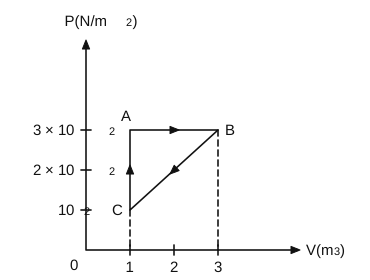
NEET 2023 (Manipur) · Q24 · Work done in the isobaric part of a cyclic process
For the given cycle, the work done during isobaric process is:
P–V diagram, P in N/m² (marks 10², 2 × 10², 3 × 10²) against V in m³ (marks 1, 2, 3), origin 0: a cycle A (1, 3 × 10²) → B (3, 3 × 10²) along a horizontal line, B → C (1, 10²) along a straight slanting line, and C → A vertically upward; dashed lines drop from C to V = 1 and from B to V = 3.
NTA's answer

Answer: (2) 600 J

From NTA's final answer key for NEET 2023 (Manipur).

NEET 2023

NEET 2023 · Q6 · Sink temperature of a Carnot engine of given efficiency
A Carnot engine has an efficiency of 50% when its source is at a temperature 327° C. The temperature of the sink is:
NTA's answer

Answer: (4) 27° C

From NTA's final answer key for NEET 2023.

NEET 2022
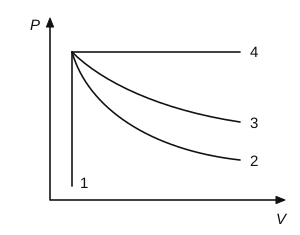
NEET 2022 · Q2 · Identifying the adiabatic curve among four processes on a P-V diagram
An ideal gas undergoes four different processes from the same initial state as shown in the figure below. Those processes are adiabatic, isothermal, isobaric and isochoric. The curve which represents the adiabatic process among 1, 2, 3 and 4 is:
P–V diagram with four paths from one initial point at the top left: 4 a horizontal line, 3 a gently falling curve, 2 a steeper falling curve below 3, and 1 a vertical line downward.
NTA's answer

Answer: (4) 2

From NTA's final answer key for NEET 2022.

NEET 2020

NEET 2020 · Q101 · Nature of the process in free expansion of an insulated gas
Two cylinders A and B of equal capacity are connected to each other via a stop cock. A contains an ideal gas at standard temperature and pressure. B is completely evacuated. The entire system is thermally insulated. The stop cock is suddenly opened. The process is:
Answer

NTA's official answer key for NEET 2020 is not in hand yet. This page will carry the answer when it is; we do not put an answer of our own in its place.
NEET 2019 (Odisha)

NEET 2019 (Odisha) · Q34 · Change in internal energy when water turns to steam
1 g of water, of volume 1 cm3 at 100°C, is converted into steam at same temperature under normal atmospheric pressure (≃ 1 × 10⁵ Pa). The volume of steam formed equals 1671 cm3. If the specific latent heat of vaporisation of water is 2256 J/g, the change in internal energy is,
Answer

NTA's official answer key for NEET 2019 (Odisha) is not in hand yet. This page will carry the answer when it is; we do not put an answer of our own in its place.

NEET 2019

NEET 2019 · Q23 · Process with no exchange of heat
In which of the following processes, heat is neither absorbed nor released by a system?
Answer

NTA's official answer key for NEET 2019 is not in hand yet. This page will carry the answer when it is; we do not put an answer of our own in its place.

NEET 2018

NEET 2018 · Q16 · Efficiency of an ideal heat engine between two temperatures
The efficiency of an ideal heat engine working between the freezing point and boiling point of water, is
Answer

NTA's official answer key for NEET 2018 is not in hand yet. This page will carry the answer when it is; we do not put an answer of our own in its place.

NEET 2018 · Q29 · Change in internal energy when water turns to steam
A sample of 0.1 g of water at 100° C and normal pressure (1.013 × 10⁵ Nm-2) requires 54 cal of heat energy to convert to steam at 100° C. If the volume of the steam produced is 167.1 cc, the change in internal energy of the sample, is
Answer

NTA's official answer key for NEET 2018 is not in hand yet. This page will carry the answer when it is; we do not put an answer of our own in its place.

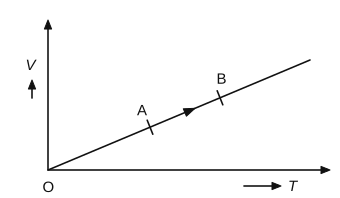
NEET 2018 · Q35 · Ratio of work done to heat absorbed from a V-T graph
The volume (V) of a monatomic gas varies with its temperature (T), as shown in the graph. The ratio of work done by the gas, to the heat absorbed by it, when it undergoes a change from state A to state B, is
Graph of V against T, origin O: a straight line through the origin rising to the right, with state A and, further up the line, state B marked on it; an arrow on the line points from A towards B.
Answer

NTA's official answer key for NEET 2018 is not in hand yet. This page will carry the answer when it is; we do not put an answer of our own in its place.

NEET 2017

NEET 2017 · Q12 · Heat absorbed by a Carnot refrigerator from the cold reservoir
A Carnot engine having an efficiency of 110 as heat engine, is used as a refrigerator. If the work done on the system is 10 J, the amount of energy absorbed from the reservoir at lower temperature is:
Answer

NTA's official answer key for NEET 2017 is not in hand yet. This page will carry the answer when it is; we do not put an answer of our own in its place.

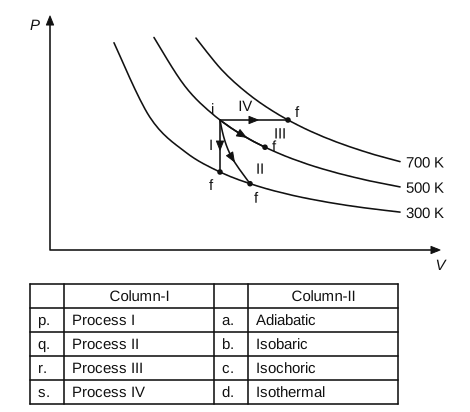
NEET 2017 · Q29 · Matching thermodynamic processes on a P-V diagram
Thermodynamics processes are indicated in the following diagram.

Match the following:
Column-IColumn-II
p.Process Ia.Adiabatic
q.Process IIb.Isobaric
r.Process IIIc.Isochoric
s.Process IVd.Isothermal
P–V diagram with three isotherms, 300 K lowest, 500 K and 700 K highest. From an initial point i on the 500 K isotherm four processes go to final points f: I, a vertical line down to the 300 K isotherm; II, a curve steeper than the isotherm, down and to the right to the 300 K isotherm; III, along the 500 K isotherm down and to the right; IV, a horizontal line to the right to the 700 K isotherm. Below the graph, a table: Column-I, p. Process I, q. Process II, r. Process III, s. Process IV; Column-II, a. Adiabatic, b. Isobaric, c. Isochoric, d. Isothermal.
Answer

NTA's official answer key for NEET 2017 is not in hand yet. This page will carry the answer when it is; we do not put an answer of our own in its place.

NEET 2016 Phase II

NEET 2016 Phase II · Q13 · Heat capacity of a gas in a polytropic process
One mole of an ideal monatomic gas undergoes a process described by the equation PV3 = constant. The heat capacity of the gas during this process is
Answer

NTA's official answer key for NEET 2016 Phase II is not in hand yet. This page will carry the answer when it is; we do not put an answer of our own in its place.

NEET 2016 Phase II · Q45 · Heat delivered to the room by an ideal refrigerator
The temperature inside a refrigerator is t2 °C and the room temperature is t1 °C. The amount of heat delivered to the room for each joule of electrical energy consumed ideally will be
Answer

NTA's official answer key for NEET 2016 Phase II is not in hand yet. This page will carry the answer when it is; we do not put an answer of our own in its place.

NEET 2016 Phase I

NEET 2016 Phase I · Q11 · Power required by a refrigerator
A refrigerator works between 4 °C and 30 °C. It is required to remove 600 calories of heat every second in order to keep the temperature of the refrigerated space constant. The power required is [Take 1 cal = 4.2 joules]
Answer

NTA's official answer key for NEET 2016 Phase I is not in hand yet. This page will carry the answer when it is; we do not put an answer of our own in its place.

NEET 2016 Phase I · Q19 · Comparing final pressures in isothermal and adiabatic compression
A gas is compressed isothermally to half its initial volume. The same gas is compressed separately through an adiabatic process until its volume is again reduced to half. Then
Answer

NTA's official answer key for NEET 2016 Phase I is not in hand yet. This page will carry the answer when it is; we do not put an answer of our own in its place.

AIPMT 2015 Re-Test
AIPMT 2015 Re-Test · Q15 · Process giving maximum work in compressing a gas
An ideal gas is compressed to half its initial volume by means of several processes. Which of the process results in the maximum work done on the gas?
Answer

NTA's official answer key for AIPMT 2015 Re-Test is not in hand yet. This page will carry the answer when it is; we do not put an answer of our own in its place.

AIPMT 2015 Re-Test · Q30 · Surrounding temperature from a refrigerator's coefficient of performance
The coefficient of performance of a refrigerator is 5. If the temperature inside freezer is –20 °C, the temperature of the surroundings to which it rejects heat is:
Answer

NTA's official answer key for AIPMT 2015 Re-Test is not in hand yet. This page will carry the answer when it is; we do not put an answer of our own in its place.

AIPMT 2015

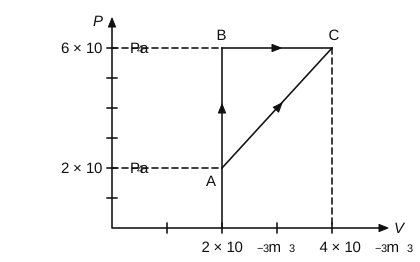
AIPMT 2015 · Q12 · Heat absorbed along a direct path using the first law
Figure below shows two paths that may be taken by a gas to go from a state A to a state C. In process AB, 400 J of heat is added to the system and in process BC, 100 J of heat is added to the system. The heat absorbed by the system in the process AC will be
P–V diagram: P with marks at each 1 × 10⁴ Pa up to 6 × 10⁴ Pa (2 × 10⁴ Pa and 6 × 10⁴ Pa labelled), V with marks at each 1 × 10⁻³ m³ (2 × 10⁻³ m³ and 4 × 10⁻³ m³ labelled). A is at (2 × 10⁻³ m³, 2 × 10⁴ Pa), B at (2 × 10⁻³ m³, 6 × 10⁴ Pa), C at (4 × 10⁻³ m³, 6 × 10⁴ Pa). Path A → B vertical upward, then B → C horizontal to the right; a straight path from A directly to C. Dashed lines from A and B to the P-axis and from C down to the V-axis.
Answer

NTA's official answer key for AIPMT 2015 is not in hand yet. This page will carry the answer when it is; we do not put an answer of our own in its place.

AIPMT 2015 · Q17 · Change in internal energy of a diatomic gas from a P-V path
One mole of an ideal diatomic gas undergoes a transition from A to B along a path AB as shown in the figure,

The change in internal energy of the gas during the transition is
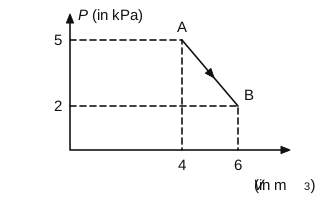
P (in kPa) against V (in m³): point A at V = 4, P = 5 and point B at V = 6, P = 2, joined by a straight line with an arrow from A towards B. Dashed lines from A and B to both axes, with marks 5 and 2 on the P-axis and 4 and 6 on the V-axis.
Answer

NTA's official answer key for AIPMT 2015 is not in hand yet. This page will carry the answer when it is; we do not put an answer of our own in its place.
AIPMT 2015 · Q30 · Heat absorbed by a Carnot refrigerator from the cold reservoir
A Carnot engine having an efficiency of 110 as heat engine, is used as a refrigerator. If the work done on the system is 10 J, the amount of energy absorbed from the reservoir at lower temperature is:
Answer

NTA's official answer key for AIPMT 2015 is not in hand yet. This page will carry the answer when it is; we do not put an answer of our own in its place.

AIPMT 2014

AIPMT 2014 · Q14 · Final pressure after isothermal then adiabatic expansion
A monoatomic gas at a pressure P, having a volume V expands isothermally to a volume 2 V and then adiabatically to a volume 16 V. The final pressure of the gas is take γ = 53
Answer

NTA's official answer key for AIPMT 2014 is not in hand yet. This page will carry the answer when it is; we do not put an answer of our own in its place.

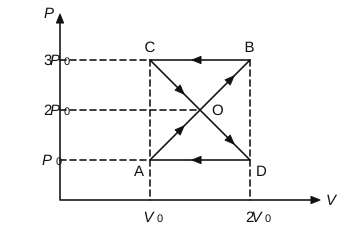
AIPMT 2014 · Q34 · Work done in a cyclic process from its P-V diagram
A thermodynamic system undergoes cyclic process ABCDA as shown in the figure. The work done by the system is
P–V diagram of cycle ABCDA: A (V0, P0), B (2V0, 3P0), C (V0, 3P0), D (2V0, P0). A to B is a straight diagonal with arrows towards B, B to C is horizontal at 3P0 with an arrow to the left, C to D is a straight diagonal with arrows towards D, and D to A is horizontal at P0 with an arrow to the left; the diagonals cross at O at pressure 2P0. Dashed lines mark P0, 2P0, 3P0 and V0, 2V0.
Answer

NTA's official answer key for AIPMT 2014 is not in hand yet. This page will carry the answer when it is; we do not put an answer of our own in its place.

Free NEET chapter practice and testsSee the Class 12 flashcards

← Thermal Properties of MatterKinetic Theory →